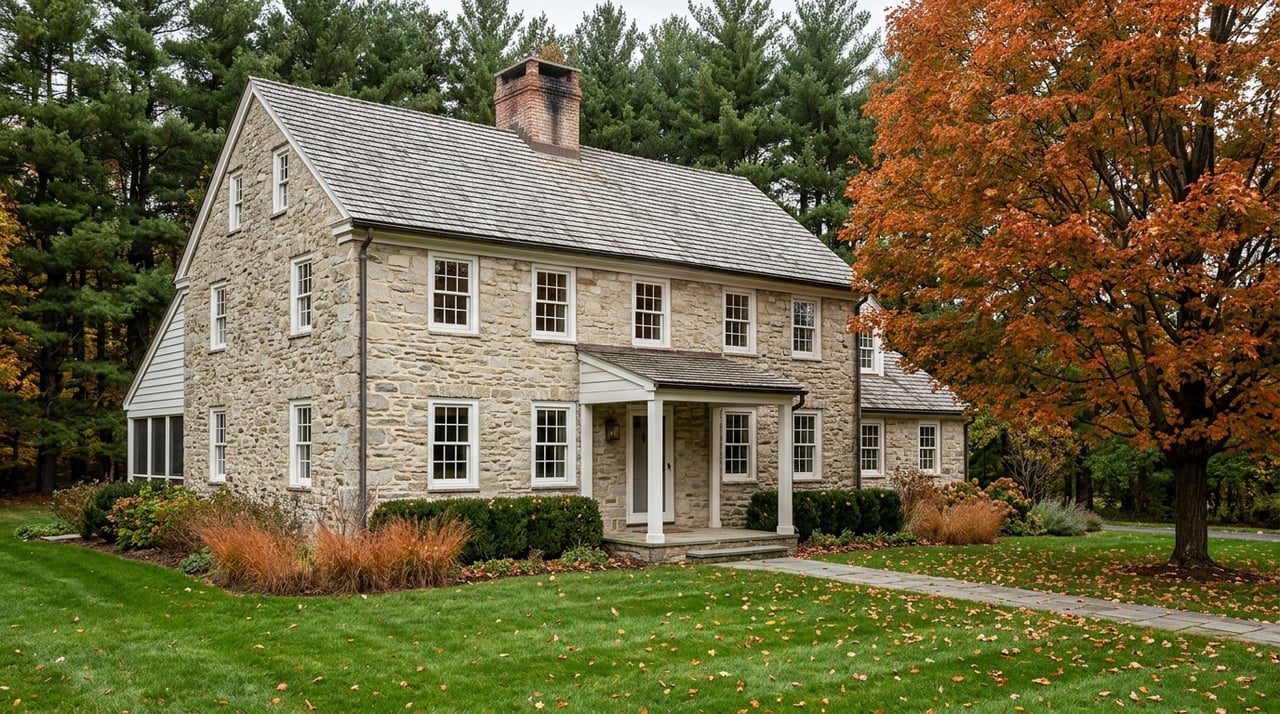
If you've taken a dog to the off-leash park at Core Creek, or launched a kayak from one of the boat ramps, or just driven Langhorne-Newtown Road on the way to somewhere else, you've passed a stone farmhouse sitting back from the road, half hidden by trees. Most people who live in Middletown Township have driven by it a hundred times without knowing its name, let alone that it sat empty for most of their lives. This past June, it opened its doors as the African American Museum of Bucks County. The building isn't new. What's new is that you can finally walk inside.
Forty Years Behind the Trees
The farmhouse is old even by Bucks County standards. The original section was built in 1716, with an addition following three years later that started as a completely separate dwelling, no doors connecting the two. A family named Boone eventually joined the sections with french doors and wrapped a two-story frame addition around one end, giving the place the modern kitchen and bath it needed to make it into the 1900s. The last owner to farm the land, a woman named Grace, kept the cows and chickens going alone for 34 years after her husband died in 1933, before selling the house and its 32 acres to Bucks County in 1967 as part of the flood control project that created Core Creek Park itself.
That's the detail worth sitting with. The farmhouse predates the park you already use. The county started restoring it after the sale, then stopped. By the time officials offered the property to the museum's founders in 2020, it had sat vacant for nearly 40 years, a stone building quietly decaying a few hundred feet from a dog park and a fishing pier that thousands of township residents visit every year.
A Museum That Already Knew Bucks County
Here's the part that surprised me most in the reporting: this wasn't a museum built from scratch and dropped into Middletown. It's a museum that had already been operating for more than a decade before it had an address. Two Bucks County residents, Harvey Spencer Sr. and Millard Mitchell, started it in 2013 as a traveling exhibit, no building, no fixed hours. For years it showed up at schools, libraries, and senior centers throughout the county, carrying artifacts and stories from town to town in what organizers called a "museum without walls." Spencer and Mitchell have both since passed away. So has Linda Salley, the retired educator who picked up the effort and pushed it toward a permanent home, who died in May at 78, just five weeks before the ribbon cutting she'd worked toward for years.
If you've ever sat through a school assembly or a library talk in Middletown Township over the past decade and seen a traveling exhibit on Bucks County's Black history, there's a real chance it was this collection, years before it had anywhere to call home.
Ground broke on the Boone Farm renovation in 2022. Getting from groundbreaking to opening took longer than planned. County officials cited unforeseen structural issues in the old building, the kind of surprises that come with converting a 300-year-old farmhouse rather than building new. The finished project, a full renovation of the stone house into a four-level museum, came to roughly $6 million.
The museum opened on Juneteenth, a date organizers say was intentional.
"It was Linda's dream that the African American Museum of Bucks County would open on Juneteenth," museum officials said at the ribbon cutting, as quoted by Patch.
What's Actually Inside
Walk in and the first thing you see is a bronze statue called "Together," cast in 1975 by Selma Burke, a sculptor who worked out of New Hope. From there, the museum spreads across seven rooms and four smaller niche exhibit spaces, tracing Bucks County's Black history from the era of enslaved labor recorded in county census records through the Underground Railroad, the county's Quaker abolitionist movement, the Great Migration, and into the contributions of Black residents across towns like Bristol, Buckingham, Langhorne, Levittown, Newtown, and New Hope. One wall lists the names of enslaved people as they appeared in county property records from the late 1700s and early 1800s, listed alongside livestock counts, the kind of primary-source detail that makes the history specific rather than abstract.
For anyone planning an actual visit, the current hours are 9 a.m. to 1 p.m. Wednesday and Thursday, and 10 a.m. to 4 p.m. Friday and Saturday. Admission runs $12 for adults, $10 for seniors and military members, and $7 for students, with entry free for members and children 5 and under. The museum sits on county-owned land adjoining Core Creek Park, off Langhorne-Newtown Road, close enough that it's realistic to treat it as a stop on a day you were already spending at the park.
The Same Park You Already Know
That's really the point. Core Creek Park isn't new to anyone reading this. It's the 1,200-acre county park most Middletown residents already build weekends around, the trails for hiking and biking, the lake for boating and fishing, the off-leash dog park recognized as one of the better ones on the East Coast. Middletown Township itself doesn't run a single off-leash dog park of its own. Core Creek, run by the county, is the only one inside township lines, which is part of why so much of local outdoor life already funnels through this one piece of ground.
The museum doesn't compete with any of that. It sits on the same acreage the county carved out in 1967, finally finished. If your Saturday already includes a walk around the lake or a stop at the dog park, the farmhouse is now a short drive from wherever you're already parked.
The timing lines up with the rest of the township's fall calendar too. Groovin' at the Gates, the township's own community festival at Forsythia Crossing Park, runs September 26 this year from noon to 5 p.m., a free event with live music, food, and a 70s theme with a costume contest. It's not at Core Creek, but it's the same kind of afternoon, the kind where you're already out in Middletown Township and looking for one more reason to stay out a little longer.
The Read
The story here isn't that Middletown Township got a new attraction. It's that the township had one all along, sitting empty behind the trees at a park most residents already treat as their backyard. It took a museum with a 13-year head start as a traveling exhibit, a $6 million renovation, and the loss of three of the people who pushed hardest to get it built, to turn a farmhouse that had been quietly falling apart since around 1980 into a place you can actually walk into. If you've been to Core Creek Park even once this year, you've been closer to this building than you probably realized.
If you're weighing a move into Middletown Township, or already call it home and are thinking about what comes next, I'd love to talk through what the neighborhood actually offers day to day, not just on paper. Amy VanDenburgh has been working Bucks County real estate since 1983 and still finds new reasons to love this county every year. Let's Connect.